
Agriscience and Agricultural Science Explained
If you are interested in current farming, food production, or agricultural education, you need to know how agriscience and agricultural science are related. Even though these terms are often used to refer to the same thing, they actually refer to two different ways of learning about and using agricultural knowledge. This piece defines agriscience, looks into its roots, and shows how it is different from standard agricultural science. It also talks about how technology has changed both areas.
What Is Agricultural Science and Its Scientific Scope
The thorough scientific study of farming techniques, crop output, animal care, and soil management is what agricultural science is all about. This field has been around for hundreds of years and has grown from simple farming understanding to a complex field that includes biology, chemistry, physics, and environmental science. Scientists who study agricultural science do tests, look at data, and come up with ideas that help us learn more about how plants grow, how animals do well, and how environments support food production.
Beyond just farming, agricultural science is a science with a very broad reach. It includes breeding and genetics of plants, ways to get rid of pests, watering systems, environmentally friendly farming methods, and programs to make sure there is enough food for everyone. Agricultural scientists work in private businesses, government agencies, universities, and research centers to find complicated solutions to issues like how to feed a growing world population while also protecting natural resources.
The scientific method is very important in agricultural science. It involves coming up with theories, doing controlled tests, gathering data, and coming to conclusions based on that data. This way of doing things has led to huge improvements in food yields, disease protection, and the use of resources. For example, in the middle of the 20th century, agricultural scientists created hybrid corn types that greatly increased crop yield. This shows how systematic study can be used to solve problems.
The field also looks at natural problems like land erosion, water shortages, and how climate change affects farming. Scientists look into the microbiology of soil to improve the cycle of nutrients. They also look into drought-resistant crop types and come up with precision farming methods that cut down on waste while increasing output.
Agronomy, animal science, gardening, soil science, agricultural economics, and agricultural engineering are some of the traditional subfields of agricultural science. Each specialty takes a lot of information and adds something new to the body of knowledge about farming.
- Agronomy is the study of growing crops and taking care of the land
- Animal science looks at how to feed, breed, and care for animals
- Horticulture is the study of plants that grow fruits, veggies, and decorations
- Soil science looks into the make-up, richness, and protection of soil
- Agricultural economics looks at policy, farm management, and market trends
- Agricultural engineering creates tools, watering systems, and buildings for farming
- Entomology studies how insects behave and how to get rid of pests
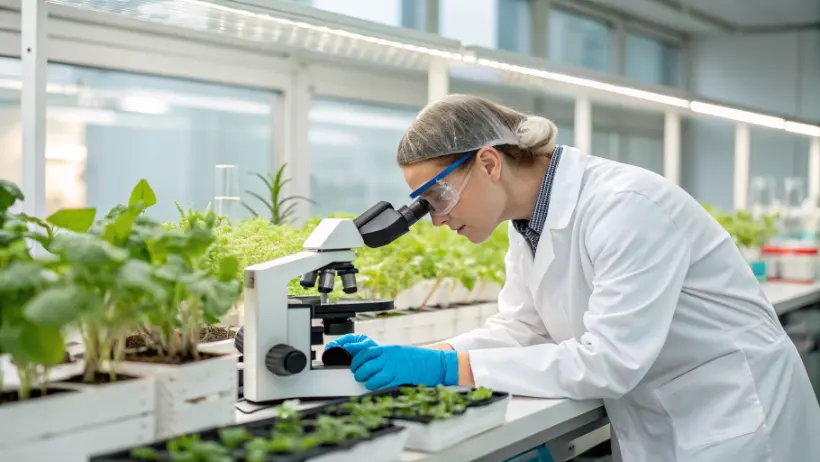
What Is Agriscience and How It Is Applied in Education
The field of agriscience uses scientific ideas in farming in a real-world way, with a focus on hands-on learning and job training. This word became popular in schools, especially high schools and technical colleges, where students learn about farming through hands-on tasks rather than just studying the ideas in a book. By mixing classroom learning with lab work, greenhouse management, and field projects, agriscience schools get students ready for jobs in farming, agribusiness, environmental management, and other related fields.
Because agriscience is mainly about education, it is very helpful for younger students who are looking for job choices. In agriscience classes, students usually learn about biology, chemistry, and environmental science in the context of farming. This makes abstract ideas more real and useful. Students could take care of animals to learn about breeding, plants to learn about photosynthesis, or dirt to learn about nutrient chemistry.
Through groups like FFA (previously Future Farmers of America) and farm education programs, many secondary schools provide agriscience paths. These programs set up organized lessons that cover basic concepts in farming, natural resources, plant and animal science, and agriculture mechanics. Students get real-world experience in addition to what they learn in the classroom by working on farms or in farming businesses while being watched.
| Subject Area | Topics Covered | Projects & Activities | Career Connections |
|---|---|---|---|
| Plant Science | Botany, genetics, crop production | Greenhouse management, garden projects | Horticulture, crop consulting |
| Animal Science | Nutrition, breeding, health | Raising livestock, veterinary care | Ranching, animal health technician |
| Agricultural Mechanics | Operating equipment, welding, fabrication | Shop projects, machinery repair | Agricultural engineering, equipment sales |
| Natural Resources | Ecology, conservation, environmental management | Water testing, habitat restoration | Environmental science, forestry |
| Agribusiness | Economics, marketing, finance | Farm management, sales projects | Business ownership, agricultural banking |
The table shows how agriscience education mixes academic knowledge with hands-on skills to make sure that students learn both what they are learning and how to do it. Agriscience differs from conventional academic science studies in that it takes an integrated approach and may not provide many chances for immediate application.
The clear goal of agriscience schools is to prepare students to work as professionals in the agriculture industry. Graduates go into a wide range of jobs, such as farm management, agricultural sales, food processing, landscape design, farming banking, and protecting the environment. Getting hands-on experience in agriscience classes gives you an edge when applying for jobs in these areas, as companies want to hire people who understand both scientific ideas and how to run a farm. Platforms like AgrowKnowledge help with this educational goal by linking students to tools, expert advice, and community networks that improve their farming knowledge and help them advance in their careers.
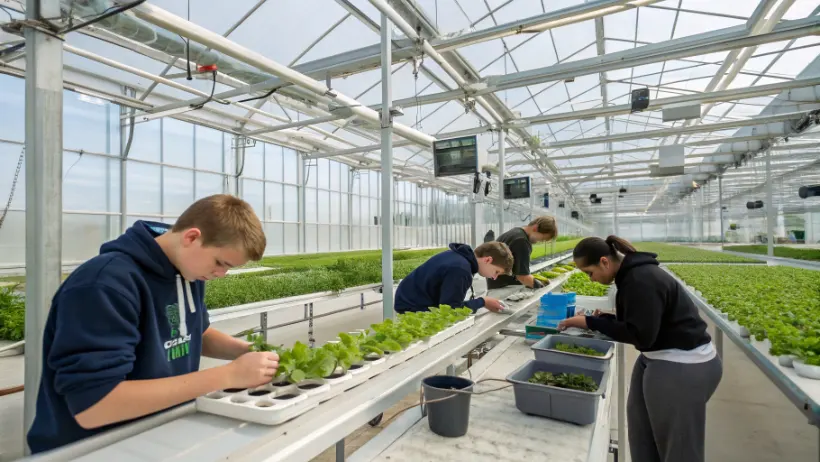
Agriscience Definition Meaning and Core Foundations
An agriscience definition includes using new tools and scientific ideas to fix issues in farming, food production, and managing natural resources. In order to improve agricultural methods, boost production, and guarantee sustainability, agriscience refers to the integration of knowledge from biology, chemistry, physics, mathematics, and technology. This description puts more emphasis on action and application than on pure study. This makes agriscience different from more theoretical scientific fields.
Understanding the biology of plants and animals, the basics of soil science, how to use technology for precise farming, how natural systems work, and how to run an agricultural business are all important parts of agriscience. These principles build a complete framework that trains people to deal with a wide range of agricultural problems.
The basics of agriscience are based on basic scientific ideas that guide farming processes. Grow physiology tells us how plants use photosynthesis to turn sunshine into energy. This helps us decide how densely to grow, when to fertilize, and how often to water. Breeding programs that make disease-resistant types or animals with desired traits use genetics to guide their work. Farmers can balance pH levels, make sure nutrients are available in the best way, and keep the soil from getting contaminated if they know about soil chemistry.
A very important basis is also understanding ecosystems and how they work together. People who work in agriscience know that farms are part of bigger environments that have effects on farming. These environments include water cycles, climate trends, and helpful insects that live in the soil. This way of thinking about systems keeps you from coming up with narrow answers that might fix one problem but make other ones worse.
More and more, modern agriscience foundations teach people how to use technology. Students and workers need to know how to use digital mapping tools, automatic systems, and information management platforms to gather data. These technology skills go along with traditional farming knowledge and help people make better decisions and handle their resources better.
- Techniques for checking soil and analyzing nutrients
- GPS-guided outdoor mapping and using of tools
- Systems that check the weather to find the best times to plant
- Managing irrigation with moisture monitors and automatic controls
- Record-keeping tools that keep track of costs, profits, and inputs
- Biological pest control and combined pest control plans
- Rules for keeping people, animals, drugs, and tools safe
Agriscience vs Agricultural Science Key Differences Explained
Agricultural science and agriscience both study the same things, but they are used for very different things and in very different ways. Researchers and scholars are the main users of agricultural science. They improve theoretical knowledge through controlled tests, systematic study, and writings that have been reviewed by other experts. Agriscience is for professionals, teachers, and students who want to work directly in farming businesses and need to know how to do things in the real world.
The difference also shows up in school settings. Agricultural science is taught at universities as specialized degrees in agronomy, animal science, or agricultural engineering. These degrees require a lot of work and often lead to chances for graduate study. Agriscience is taught in secondary and trade schools as a way to get a job. These career paths may or may not include college, but they always stress developing hands-on skills.
The scientific method is strictly followed in agricultural science, with hypothesis testing, experimental tests, statistical analysis, and results that can be repeated being the most important steps. It could take years to finish a piece of research, which is then published in academic papers and shown at scientific gatherings. This process makes sure that things are accurate and reliable, but it might not seem like it has anything to do with farming.
| Aspect | Agricultural Science | Agriscience |
|---|---|---|
| Primary Goal | Create new knowledge | Apply existing knowledge |
| Primary Impact | Research | Practice |
| Primary Audience | Scientists, researchers, academics | Students, farmers, agricultural workers |
| Focus | Theory | Application |
| Methodology | Controlled experiments, peer review | Experiential learning, skill development |
| Results | Long-term | Immediate |
| Educational Level | University, graduate programs | High school, technical colleges |
| Scope | Specialized | Foundational |
| Time Horizon | Years for research completion | Seasonal cycles, project-based |
| Output | Publication | Production |
Agriscience looks at things in a more practical way, asking how current scientific information can be used to solve problems or make things better. An agriscience student learning about nitrogen fixation might plant legumes and check how they affect the fertility of the soil. On the other hand, an agricultural science researcher might look into how nitrogen-fixing bugs work at the molecular level in the lab.
Agricultural scientists usually work in research centers, colleges, or specialized labs. They add to the body of scientific writing and help people understand theories better. Their work shapes policy, sets standards for the business, and gives the knowledge base that people who work in agriscience use. Agriscience workers use scientific discoveries to run farming businesses and teach others about farming in agribusiness, extension services, industrial agriculture, or other related fields.
"Agricultural science discovers what works and why, while agriscience takes those discoveries and translates them into practical solutions that farmers, ranchers, and agricultural businesses can implement immediately."
This connection between research and practice is mutually beneficial for the whole agricultural sector, as problems in practice help set research objectives.
Exploring Agriscience and Technology in Modern Agriculture
Technology has changed both agricultural science and agriscience, making it possible to be more precise, efficient, and environmentally friendly than ever before. Today's farmers use GPS-guided machines to plant seeds with centimeter-level accuracy, drones to check on the health of crops across huge areas, and sensors to get real-time information about the temperature, wetness, and nutrients in the soil. Because of these changes in technology, people who work in agriculture need to know both how to farm traditionally and how to use computers.
Along with biological and technical skills, agriscience education is putting more and more emphasis on technology skills. Students learn how to use complicated machines, figure out what data from different tracking systems means, and make decisions about how to run a farm using software. The combination of technology and farming is a big change from the way farming was done in the past, but it still has some roots in basic farming principles.
Precision farming is an example of how technology can be used to improve agriscience. Farmers can handle different areas of their fields more effectively by collecting thorough information about things like soil types, water patterns, pest populations, and changes in crop yields. This way, they don't have to treat all of their fields the same way. Variable rate application technology lets you precisely place fertilizer, which cuts down on costs and damage to the environment while keeping or increasing crops.
Data analytics systems collect data from many sources, look for trends, and guess what will happen. Farmers can guess how much water they will need based on the weather, guess when pests will appear by looking at past data and present conditions, or choose the best time to gather for quality and profit. To do these things, you need to know both the basic ideas behind farming and the technology tools that make it easier to collect and analyze data.
Biotechnology is another area of agriscience where technology has a big effect. Genetic engineering has made it possible for crops to have better qualities, like being able to handle weather, being resistant to pests, and having more nutrients. This solves problems that traditional breeding methods couldn't solve fast enough. Agricultural scientists work on these technologies in study labs, but people who work in agriscience need to know how to use them, what their pros and cons are, and what the rules are.
"Technology doesn't replace the need to understand fundamental agricultural principles; it amplifies our ability to apply those principles more precisely and effectively than ever before."
Students studying agriscience today learn about CRISPR gene editing, marker-assisted selection, tissue culture growth, and other bioengineering tools that will influence food production in the future. This information helps them get ready for jobs in a farming world that is getting more complex.
In farmland, automation is still getting better, with robotic systems doing jobs that used to require a lot of human work. Automated milking systems run dairy farms, robotic harvesters go through gardens picking fruit, and self-driving tractors do work in the fields. These technologies make things more efficient and cut down on labor costs, but they need skilled workers who know how to use both the machines and the farming tasks that are being computerized.
Robotics and automation training is now part of agriscience classes because it is known that future farmers will need to know how to manage and improve these systems. This change in technology doesn't make biological knowledge less important—understanding the stages of plant growth is still needed to train harvest robots correctly—but it does add new aspects to agricultural knowledge.
How AgrowKnowledge Connects Agriscience and Agricultural Science
It is very important to connect agricultural science study with agriscience practice through educational platforms and information networks. These resources make scientific finds easy for professionals to use, give teachers up-to-date information and teaching materials, and build groups where agricultural professionals can share their experiences and new ideas. These kinds of platforms make it faster for scientific information to be put to use by connecting researchers, teachers, students, and people working in the business.
A good farming education knows that students need to know a lot about science and be able to use what they've learned in the real world. These types of programs make workers who can think critically, solve problems, and adjust to new situations, which is exactly what modern farming needs. Digital tools make it easier for more people to get expert knowledge. This way, students in remote places can benefit from cutting-edge study, and experts can keep up with new technologies.
The best farming education is when students can directly apply what they've learned in the classroom to real-life situations. When students learn about the biochemistry of photosynthesis while also running a garden, they understand it better than if they just listened to classes. In the same way, farmers who understand the scientific concepts behind precision agriculture suggestions can change those suggestions to fit their own needs instead of mindlessly following instructions.
Knowledge networks make these links easier by collecting information, breaking down complicated study into formats that are easy to understand, and giving people places to talk and work together. They make sure that agricultural scientists know what the real limits and goals are, and they keep practitioners up to date on the latest scientific findings that affect their work. This two-way flow of information makes both agricultural science and agriscience stronger, which makes the whole food production system better in the long run.
As new tools come out and new problems come up, agriculture is always changing. Because of climate change, growth conditions change, buyer tastes change, rules change, and economic factors change. To stay useful in this changing world, people who work in agriculture need to keep learning. Comprehensive knowledge tools help people learn throughout their lives by giving them access to up-to-date information, chances to improve their skills, and experts who can help them.
Having easy access to educational tools makes agricultural knowledge more democratic and widespread. This is true whether someone wants to learn basic agriscience, understand advanced agricultural science research, or find useful answers to specific problems. This makes learning easier for everyone, which is good for individual students and the agriculture sector as a whole because it raises the level of information and skill across the board.
Frequently Asked Questions
What is the main difference between agriscience and agricultural science?
Agricultural science focuses on research and developing new knowledge through controlled experiments and academic study, typically at the university level. Agriscience emphasizes practical application of scientific principles in farming, with hands-on learning primarily at the high school and technical college level to prepare students for agricultural careers.
What does agriscience mean in education?
Agriscience meaning in education refers to the integration of scientific principles with practical farming applications through hands-on learning. It combines classroom instruction with laboratory work, greenhouse management, and field projects to prepare students for careers in farming, agribusiness, and environmental management.
What are the core foundations of agriscience?
Agriscience foundations include understanding plant and animal biology, soil science basics, precision farming technology, ecosystem interactions, and agricultural business management. Modern foundations also emphasize technology skills such as GPS mapping, data analytics, automated systems, and digital farm management platforms.
How has technology changed agriscience education?
Technology has transformed agriscience by introducing GPS-guided equipment, drones for crop monitoring, soil sensors, data analytics platforms, and precision farming tools. Students now learn to use digital mapping, automated systems, and farm management software alongside traditional agronomic knowledge, preparing them for technology-integrated farming careers.
What careers can agriscience education lead to?
Agriscience education prepares students for diverse careers including farm management, agricultural sales, food processing, landscape design, agricultural banking, environmental conservation, equipment operation, veterinary assistance, crop consulting, and agribusiness ownership. The hands-on training provides practical skills valued by employers across the agricultural industry.